“Sports should be inclusive for everyone and one should not feel the need to decide between what they wear and pursuing a sport due to a lack of a product or solution.”
For many women around the world the hijab is just another item of clothing that they put on without giving it any thought. Wearing it every day has become second nature to them. Like putting on underwear. With this being the case, there are many women that feel they are excluded from being able to do things that any other average women do. Participating in their favourite sport for instance. No matter how phenomenal the Hijab-wearing woman is at the sport she loves, there was never any practical way for her to show the world. Unless she shows her hair.
Over the years there has been the debate around inclusivity of Muslim women in the sporting industry. It deals with more than them not being given the same equal opportunity as men, but as other women. Everyone is constantly preaching the message of women needing to uplift other women in this 21st century patriarchal society, but tend to neglect specific groups of women. Namely, Muslim, Hijab-wearing women. Are they not women as well? Or do they just not fit the bill of the type of women we aim to uplift, empower and include?

In recent years (as recent as 2017), Nike released their first Pro-Hijab wear. This meant that Muslim women finally had a hijab that they could wear when running, playing tennis, weight-lifting (yes us Muslim women can do that too) and do basically any other sport thinkable. This is all while minimising the practical challenges of wearing a religious item of clothing. It was about time an influential sportswear brand changed the face for sporting Muslim women. They gained worldwide recognition for finally recognising the Muslim-women minority. With this item of clothing some of the practical barriers that exists between religion and exercise can be broken down.
“During my career, it was difficult to find a sports hijab that looked simple yet functional. The one piece I had was a regular cover, similar to a hoodie and its material was cotton, not the very breathable type,”
-Amna Al Haddad, female weighting lifting champion from UAE and one of the faces of Nike’s Pro-Hijab.
With the release of the Pro-Hijab there was of course controversy. While there is a large portion of people who stand behind the inclusivity of Muslims in the sporting industry through the making of the Pro-Hijab, there are those who have scrutinised both the Nike brand as well as the product. Those who disagree with the product feel as though Nike is normalising and supporting the oppression of women, like Islam does. Which, might I add, is ignorant.

Ibtihaj Muhammad wearing the Nike Pro-Hijab.
Those that know Islam and its practices, know that there is nothing oppressing about wearing a headscarf. In fact, most women that wear their Hijab have chosen to do so out of their own, and not because they were forced. This is a common misconception. Yes, you get those who have parents, or husbands who try to control every move of their daughters and wives so they tell them that they have to wear a Hijab, but you get that in every religion. It may not be in the form of a Hijab, or as visible as a Hijab, but male dominance still presides in today’s society.
Now let’s talk about why it’s always the biggest news when Muslim sportswomen wear their Hijab during an event. Why has it not yet been normalised? When these women go onto the field they do not think about what the world will say about them wearing what they consider to be an everyday item of clothing. To them they are simply being who they are, doing what they love and excel at. The hijab is a means of diversion from unwanted attention. The women wearing them do not want to be noticed for what they are wearing but rather for the immense talents they possess.
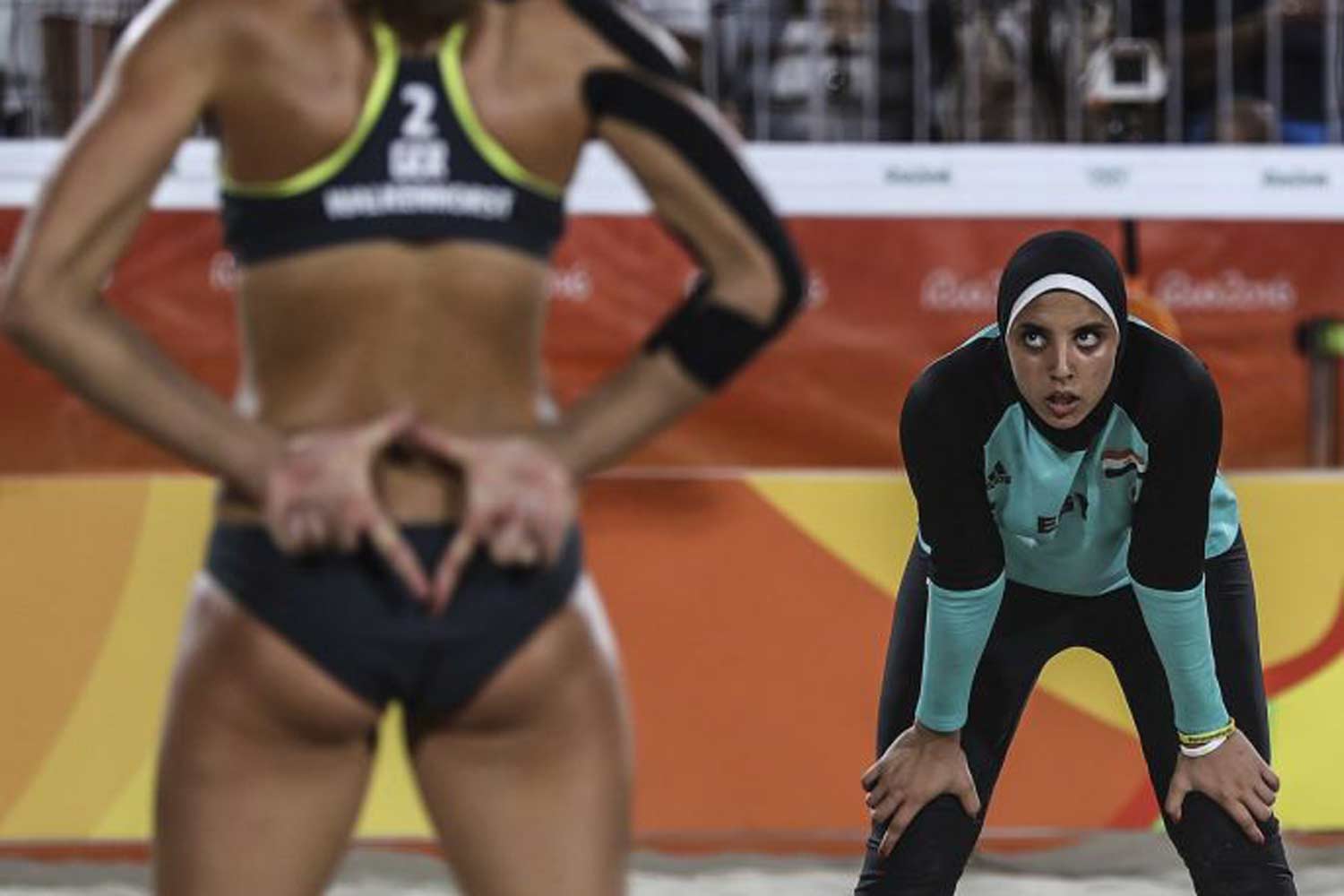
Elghobashy, playing beach volleyball in her Islamic attire.
For most, the discussion around wearing the hijab in sport is relatively new but for Muslims, not so much. The instant media-attention received when an athlete, of any sport, comes out wearing a hijab shows the lack of understanding that the rest of the world seems to have. It means that we are subject to an era where being Muslim is not yet accepted by the masses so we have to constantly remind people that, yes, there are Muslims in the world who play sport and are good at it. I mean Ibtihaj Muhammad did win bronze at the Olympics in 2016, making her the first Muslim-American to stand on the podium.
“I am looking forward for the day where the media stops focusing on such issues and focuses on the person’s talent, willpower, and human spirit instead of their religious beliefs tied to their opportunity in sports. Sports can’t tell whether you’re Muslim, Jew, Christian, Arab, African-American, Atheist or one’s sexual orientation. It knows talent, whether you can perform or not. This what makes sports beautiful.”
-Amna Al Haddad
In today’s time, the hijab can be seen as more than just a symbol for Muslim women, but also as an opportunity for a more open discussion about the inclusion, diversity, understanding and normalisation of the hijab in all facets of the world. The world needs to become more open-minded about the fact that there are Muslim women in the world that are physically active. The stigma around all Muslim women being stay-at-home mothers who cook, clean and take orders from their husbands is yet to be removed. We are not oppressed beings (well not by our families and communities at least).
There is yet lots for the world to understand about Islam. One thing they should know, however, is that the religion always has, and always will encourage the participation of all in physical activities. There has been no restriction against us partaking in sports of any kind. On the contrary, Islam places a strong emphasis on the importance of keeping a healthy body and mind.
When society realises that there are more women that need empowering and to be included, that is the day the world changes. The struggles of women, fighting to get recognised for their worth, are not limited to only those who are fighting battles against men. We need to be fighting for all women and not just those whom we wish to fight for.
Click here to watch interview:
https://www.youtube.com/watch?v=hTfphcE3eJY&t=13s
 Real Talk